

Ultra-Processed Food is the Problem
Why UPF, not cheap calories, is a more plausible explanation for increasing rates of obesity

Cigarettes vs. Chips. vs. Rice
In a recent post arguing that Ultra-Processed food is not the primary driver of increasing rates of obesity, Matthew Yglesias compares eating to smoking. In his smoking days, he says, he favored Camel Lights, and so you could fairly say that while he smoked the damage to his lungs was being caused by that brand specifically, not cigarettes generally. But if he preferred Pall Malls or Winstons or Gauloises, then these would have been responsible for the damage. The point is that in the case of any individual person one specific brand of cigarette does the damage, but at the population level cigarettes as a category are the problem, and it would be absurd to argue otherwise.
Yglesias think food is similar. You might favor chips, ice cream, and soda, and I might favor unseasoned rice, but the problem in both cases is the abundance of cheap food. You’ve got chips in your pantry, of course, but you can also easily pick up a pack as you check out at the gas station, and your work has a couple vending machines. You never have to go without for more than a couple hours, and most days, between your commute and your lunch break, you fit in three or four sodas without even thinking about it. It’s slightly harder for me to keep unseasoned rice close at hand, but I’m so obsessed that I’ve invested in a good rice cooker and a small portable cooler, which do the job. I meet you at the ice cream parlor, but I BMOR. When I have people over for dinner I make twice as much rice as my guests could possibly eat, and we all end up stuffed to the . I sneak rice into the movie theater.
The good news for me is that bulk rice is even cheaper than chips on a per calorie basis, so the cooler and the cooker quickly pay for themselves, especially since I never shop at convenience stores. The bad news is that both of us overeat precisely the same amount. You can’t get enough Doritos and Coke, while I’m constantly shoveling unseasoned rice into my mouth. As Yglesias says, “we should understand the human animal as having evolved to overeat a modest amount whenever food is widely available in order to hedge against starvation risk in the future.”
I’m being facetious, but the absurdity of the scenario points to the obvious, intuitive flaw in ascribing everything to the cost and availability of calories. Here’s another way to think about it: imagine replacing all cheap snack food with even cheaper pouches of pre-cooked, shelf-stable, unseasoned rice. These pouches would make it easy to eat on the go (think Go-Gurt) and they could be sold at cash registers, given away as party favors, stocked in company break rooms. Perhaps you disagree, but for my part I simply cannot imagine that people would replace calories from chocolate with an identical number of calories from rice. Fortunately, we don’t need to rely on intuition and an imagined world of rice to adjudicate these questions.
The Relationship Between GDP and Obesity Rates Is Far From Simple
Yglesias argues that the increase in weight has been steady for as far back as we can trace it. In the 19th and early 20th century malnutrition was so prevalent that increased weight usually meant less stunting and greater adult height. But height is genetically limited, and when it was maxed out we started growing wider instead of taller. This trend plays out globally as countries grow more affluent, so Spain and Greece, for all the vaunted healthfulness of the Mediterranean diet, have more obesity than Poland.
But there are dramatic counterexamples. Samoa has a per capita GDP of $3800 and an obesity rate of 53%, while Japan has a per capita GDP of $34000 and an obesity rate of less than 5%. Canada has per capita GDP of $55000 and an obesity rate of 28%, while Jordan has a per capita GDP of $4000 and an obesity rate of 34%. The very poorest countries have extremely low rates of obesity, but beyond that the picture gets more complex. There is clearly some relationship between affluence and obesity rates, but there are numerous outliers to the trend.
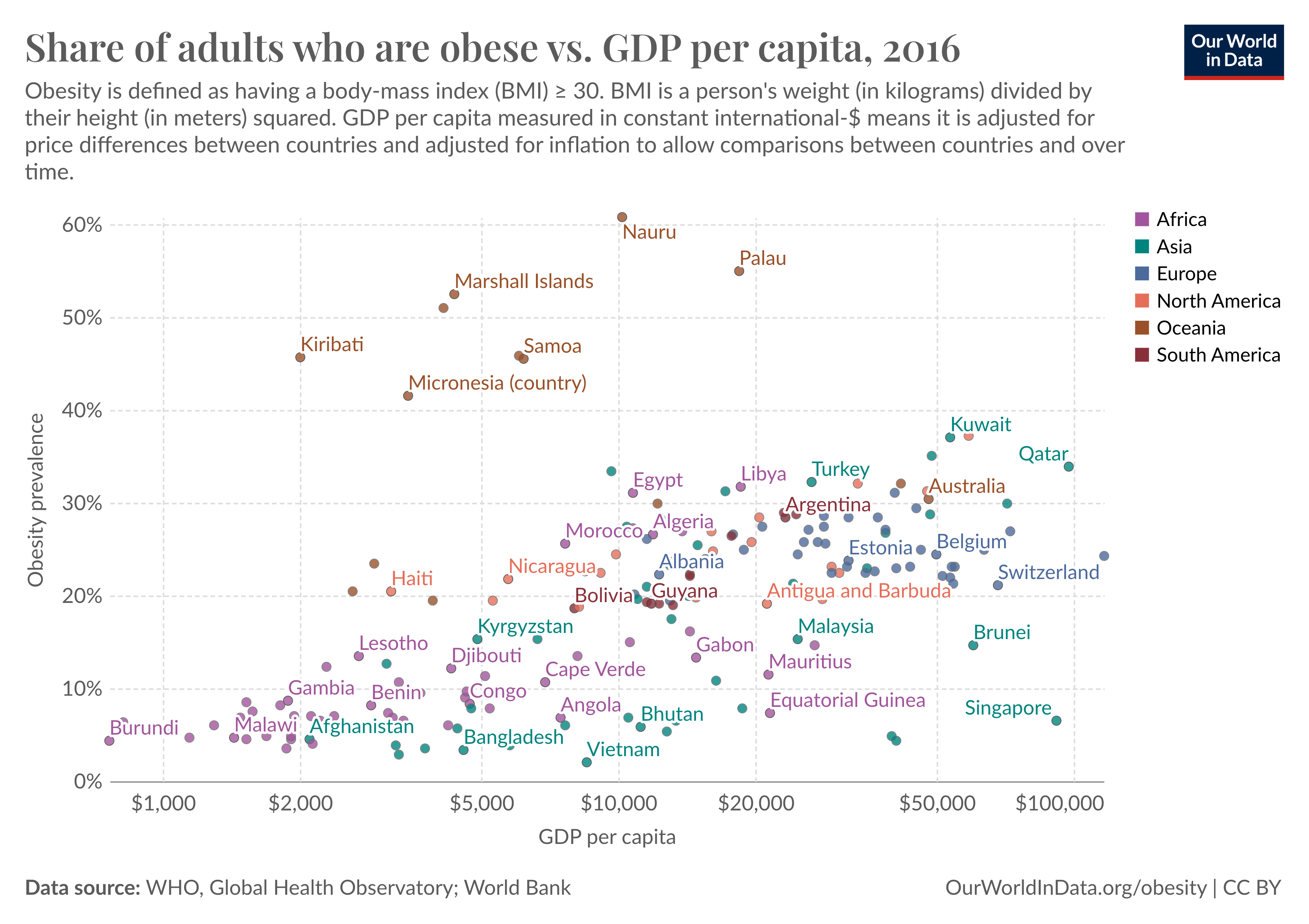
Further, ultra-processed food accompanies economic growth. With the shift from subsistence farming to more efficient agriculture, urbanization, and increasing participation in the global economy, a country’s food system will undergo a radical transformation from less to more processing. More people have access to an abundance of calories, but the types of food those calories come in also changes. Given the range of outcomes, from poor countries with extreme obesity and developed countries with relatively low rates to everything in between, it is far more plausible that an interplay between the types of food available and the culture around their consumption is more important than the pure availability of cheap calories.
We Have One Good Study
Nutritional studies are notoriously difficult. Food questionnaires are unreliable, confounders are numerous, and the impacts of diet take so long to play out that the effect of any single variable gets lost in the noise. When the best epidemiology shows that ice cream is healthy it is not evidence that you should stock up on Ben and Jerry’s, it is evidence that you should be very skeptical of nutritional epidemiology. On the other hand, tightly controlled dietary studies can be conducted in a metabolic ward, which allows intake to be accurately assessed. But such studies are incredibly expensive compared to correlating health outcomes with self-reported diet, and they can only run for a few weeks, which limits their usefulness for connecting diet to long-term outcomes like cardiovascular disease or cancer.
But one metabolic ward study has looked at the question of ultra-processed food and excess caloric intake. It used an ingenious design to make up for the fact that it had only twenty subjects. These were randomized into groups of ten. For two weeks one group ate three meals a day plus snacks of entirely ultra-processed foods, while the other ate matched meals and snacks cooked from minimally processed food. Then they switched, with the ultra-processed group shifting to minimally processed, and vice-versa. In all cases subjects were allowed to eat as much as they wanted. The upshot was that regardless of the order in which they were exposed participants ate an extra 500 calories on average when consuming the ultra-processed food diet.
There are obvious limitations to this study. The sample size was minuscule and the length was short. Though having subjects serve as their own controls does make it far more compelling than it would otherwise be, better still would be a similar study conducted over months with more participants. Nevertheless, its conclusion — that people will voluntarily eat more of foods that have been engineered to encourage people to eat more of them — makes quite a lot of sense.
While the idea that a complex relationship between the food system and the culture of eating determines obesity rates may not be particularly satisfying (how could we intervene? What are these cultural factors? Isn’t ‘food system’ so all-encompassing as to be meaningless? Some UPF must be harmless, right?) it is simply far more plausible than the idea that the availability of cheap calories is the driver.
Ultra-Processed Food Isn’t a Perfect Explanation
The problem with the position that ultra-processed food drives increasing rates of obesity is that outlier countries like Japan are not oases in which everyone cooks from scratch. This study of UPF consumption in Japan should be taken with a big grain of salt, since its employed a diet-recall survey of a potentially non-representative sample. But even if the finding that 30% of calories in the standard Japanese diet come from UPF isn’t perfect, there’s no reason to dismiss it completely. At the very least it suggests that the average Japanese person is no stranger to UPF. If the relationship between UPF consumption and obesity was linear, Japan would see more of it.
Most likely, at the population level something more complicated than readily available calories or the availability of ultra-processed food explains variations in rates of obesity between countries. Food culture, I suspect, plays a big role. But on the balance I think UPF — the form in which calories are delivered — has more to do with eating patterns than the relative cost and convenience of calories.