

Why Lab-Grown Meat Will Never Arrive
What Impossible and Beyond Meat tell us about the future of fake beef

Whether or not lab grown meat ever makes it into grocery stores will hinge on cost. No one disputes the fact that certain genetic lines of cow cells can be induced to duplicate in controlled circumstances, but whether it will ever be an economically viable way to produce a substitute for ground beef is another matter. Proponents of lab grown meat say the technological advances and the economies of scale will so radically drop prices that sooner or later it will be cheaper than conventional meat, while skeptics say the process is too finicky and complex for these supposed cost savings to ever materialize. This is usually where the conversation ends.
But stopping there ignores a useful comparison that has already made it to the supermarket. Beyond Meat and Impossible Foods sell meat substitutes that you can go buy right now. While they remain niche products compared to normal meat, both companies have a nationwide presence, and both have been operating for a few years. Just like lab grown meat, they aim to replace purchases that would normally be made from the butcher’s case.
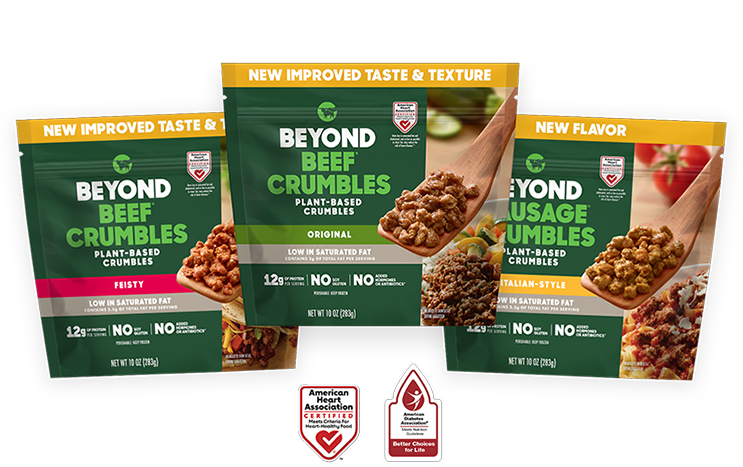
Both are made by combining soy or pea protein with a variety of flavorings and texture modifiers that give them a resemblance to actual meat. In the past fifty years the food industry has become adept at isolating proteins, starches, and fats, then recombining them with emulsifiers and flavorings, something I’ve written about this before in the context of Ultra Processed Food. Beyond and Impossible use this methodology to create facsimiles of meat. In the case of Impossible, a genetically modified strain of yeast produces heme protein to make it more convincing.
So what do they cost, and what does this tell us about lab-grown meat?
I looked for the best prices I could find online, and both Beyond and Impossible have a cost of about $0.12 per gram of protein. I then looked at my local grocery store’s website, and their middle tier ground beef cost $0.06 per gram of protein. No doubt buying in bulk at Walmart would be a bit cheaper. The upshot is that, when used as a 1:1 protein substitute, the best fake ground beef currently available costs about twice as much as the real thing.
How different is lab-grown meat?
While lab grown meat proposes an approach that is very different from conventional food processing in some ways, in others it is remarkably similar. Cultured meat cells can spontaneously replicate, but to do so they need a carefully calibrated blend of nutrients and signaling chemicals. The most economically feasible source of many of these is the same isolated food components that go into products like Impossible and Beyond.
To grow, lab-grown meat requires glucose, amino acids, vitamins, salts, buffering compounds, and bovine fetal serum. My guess is that the cheapest source of amino acids will prove to be soy, and the cheapest source of glucose will prove to be corn or rice. The serum is a major hurdle, and lab grown meat companies are very close mouthed about how they’re trying to solve it. There are a variety of proposed work-arounds. I would bet that using an animal-derived alternative will prove the most viable way forward, but perhaps someone will engineer bacteria to produce the critical components of bovine fetal serum.
From my outside vantage lab grown meat looks like it has all the complexity of a meat substitute combined with the complexity of a hugely scaled up biomedical process. I suspect the first half of this equation alone — turning soy, corn and other raw materials into the feedstock for lab-grown meat — will cost at least as much as it does when used to produce an Impossible Burger. And the second half of the equation will require significant breakthroughs to function at scale, to say nothing of cost of running a facility that is half brewery, half biotech.
The savings aren’t there
The notional savings of lab grown meat come in the form of reduced input costs. It is more efficient to convert amino acids straight into beef cells, rather than having a cow do it. Put another way, a cow has to eat a lot more soybeans (not that a cow should ever be eating any soybeans!) to make one gram of beef than taking those same soybeans and using them to feed beef cells growing in a petri dish.

But Impossible and Beyond should already be realizing these savings; indeed, Impossible meat substitute is mostly soybean. Yet both are still far more expensive than conventional beef, to say nothing of cheaper proteins like factory farmed chicken. It’s true they are in a small niche that isn’t nearly as mature as industrial animal agriculture. If they get bigger or if newer competitors come on the market, costs will come down. I wouldn’t be surprised to see a really good meat substitute achieve cost parity with conventional meat in the coming decade.
What I don’t see is how lab grown meat will get there. I’m not going to lay out all the math, but I’ve looked into what it costs to take barley to beer, milk to cheese, milk to yogurt, flour to bread, cabbage to sauerkraut, and in every case the processing is a much larger share of the cost than the inputs. You could argue that the same is true of livestock, that they “process” corn and soy into meat, which is fair, so far as it goes. My point is that these inputs are really, really cheap, so a less input efficient process, like using a cow or a chicken to make meat, can make economic sense if it also costs a lot less than a more input efficient process like using food science to turn soy protein in fake beef.
What would change my mind
I’ve been seeing more and more people claim that it’s fine if it takes fifteen or twenty years to work out a method to efficiently produce lab-grown meat, or that we need an Apollo Program for lab-grown meat, or that even if there’s only a 1% chance of lab-grown meat working out, the upside is worth it. Meanwhile, I’ve gone from expecting lab-grown meat to hit store shelves (and maybe put me out of business) to believing it will simply never arrive.
If you are in the first group, and you want to convince me that lab-grown meat is anything but an expensive boondoggle, that there’s even 1 in 100 and not 1 in 1000 chance that it can be economically competitive with conventional meat, show me the cost estimates you are using for each step of production and for each of your inputs, along the best real-world comparisons that are currently deployed at scale. Show me a plausible scenario in which lab-grown meat becomes cheaper than the far simpler meat substitutes that already exist.
(a version of the article appeared on my farm’s blog)
I’m not going to argue with any of that, Garth!